Vietnamese
Japanese
Alexandre Rhodes and Nguyen Van Vinh
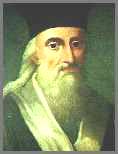
Alexandre de Rhodes
(1591 - 1660)
|
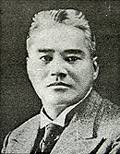
Nguyen Van Vinh
(1882 - 1936)
|
Nguyen Van Vinh was born in 1882 in Hanoi,
the same year when Hanoi was taken by the French army. His parents were
poor
and could not pay for their chidren's education. To earn money to help his
family, the eight-year-old Nguyen Van Vinh had to work at a school for
interpreters
in Hanoi. His work was to pull a bamboo fan hung under the class ceiling
to get fresh air when the class was going. This allowed him to watch and
listen to the French teacher, and he managed to learn and memorize quickly
all the lessons. His brilliant ability was soon noticed by the teacher, who
requested the school director to give him a scholarship to study in this
school. He finished the school at the age of 14, topping the graduation
exam,
and became an excellent intepreter. He was then appointed to be the
assistant
of French governor of Bac Ninh province.
In 1906, at the age of 24, Nguyen Van Vinh was sent to
an exposition fair in Marseille. He had been aware of the important role
which the press could play in Vietnam in the modernizing process, so on
this
trip he intended to learn as much as he could about this subject. He was
the first Vietnamese who joined the French Society of Human Rights.
Back to Vietnam, Nguyen Van Vinh resigned from his post
and devoted himself to journalism. In 1907 he served as the editor-in-chief of the Dang Co Tung Bao, which was the first
newspaper with
"quoc ngu" printed in Tonkin (North of Vietnam). In 1913 he was the editor-in-chief the Dong
Duong
Tap Chi (The Indochina journal), where one learned to use "quoc ngu" to
write
literature. He was also the first author who translated masters of French
classical literature, such as Balzac, Victor Hugo, Alexandre Dumas, La
Fontaine,
Moliere, etc. into Vietnamese "quoc ngu", as well as the famous Vietnamese
novel in verse "The tale of Kieu" by Nguyen Du into French. His effort
helped
the Western knowledge and culture to spread among the population and
facilitated
the acceptance of quoc ngu by the Vietnamese society. In 1918 Kinh Khai
Dinh
declared "quoc ngu" to be the official writing language of the country.
Chinese
characters were officially abolished.
Nguyen Van Vinh, however, could not earn living with his
journalist and publishing carreer. His publishing house went bankrupt and
his properties were confiscated. He went to Laos in a gold-rush and died
there in 1936. His body was found in a boat by a river at Sepon (southern
part of Laos) with a pen and a notebook still hold in his hands. He was
writing
his last report until his last minute. When his coffin arrived by train at
Hanoi, thousands of Hanoians were waiting in a solemn silence at the main
gate of the Central Railway Station to bid farewell to the man whose talent
and tireless effort had made "quoc ngu" really become their written
language.
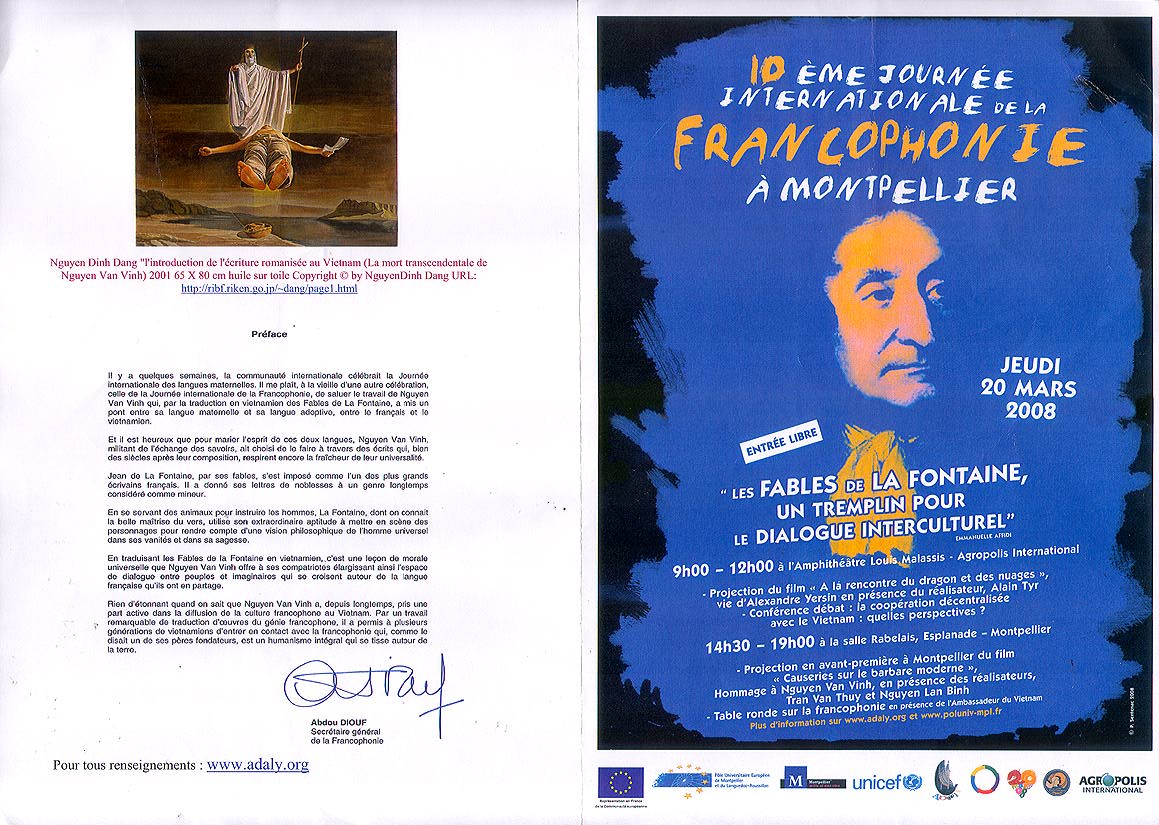
It is in homage to these two great men, Alexandre de
Rhodes
and Nguyen Van Vinh, that the painting "The
Introduction of Roman Writing into Vietnam (The Transcendental Death of
Mr. Nguyen Van Vinh)" was created.
Nguyen Dinh
Dang
March 2001, on the occasion of 350th
anniversary of the first Vietnamese dictionary by Alexander de
Rhodes)
Some articles about Alexandre de Rodes and Nguyen Van Vinh:
 Nguyen
Van Vinh - the cutural bridge between East and West (by Hoang Tien, in
Vietnamese)
Nguyen
Van Vinh - the cutural bridge between East and West (by Hoang Tien, in
Vietnamese)
"'The
modern barbarian': Nguyen Van Vinh and the complexity of colonial
modernity in Vietnam" (by C.E. Goscha)
Should we rewrite
history ? (by Jacques Roland, Viet. trans. by Nguyen Dang Truc)
D'Alexandre de Rhodes a Nguyen Van Vinh (by A. Owhadi-Richardson)
10th International Journey of Francophony in Montpellier